
How to Buy Life Insurance, From Coverage Estimate to Issued Policy

The life insurance buying process step by step is: set a coverage target, compare policy types, prepare an application, complete any underwriting, and review the offer before accepting it. The NAIC says accelerated underwriting can reduce the process to hours, while traditional issuance may take months. Your health and needs shape the route.
Buying life insurance is easier when you separate the decision into a few checkpoints. First decide what the death benefit should accomplish. Then choose the type of policy, prepare accurate information, and leave time for the insurer to review the file. For a broader overview, the easiest life insurance buying process guide covers the cluster topic.
- The Insurance Information Institute recommends starting with household needs such as final expenses, debts, income, and services that would need to be replaced, then subtracting available resources.
- Traditional underwriting may include a physical exam, fluid testing, and medical-record review; accelerated underwriting may use external data instead.
- The application is only a request for coverage. The insurer sets the final terms after reviewing the completed file.
- Read the policy form and delivery documents before accepting the offer. Confirm the premium, benefit, term, beneficiaries, exclusions, and optional riders.
If you want an estimate before gathering every document, use the site’s estimate path after you have a rough coverage target. It can show a starting point, but it is not an approval or a promise of final terms.
See your estimated rate in minutes.
Prefer to talk it through? You can speak with a licensed life insurance agent.
- Estimates before any agent call
- No contact info needed
- Online estimates not available in New York
What are the main steps in buying life insurance?
The main steps are to define the purpose and amount, choose a policy type, prepare the application, complete underwriting, and review the issued policy. Keeping those decisions separate makes it easier to spot a gap before you commit.
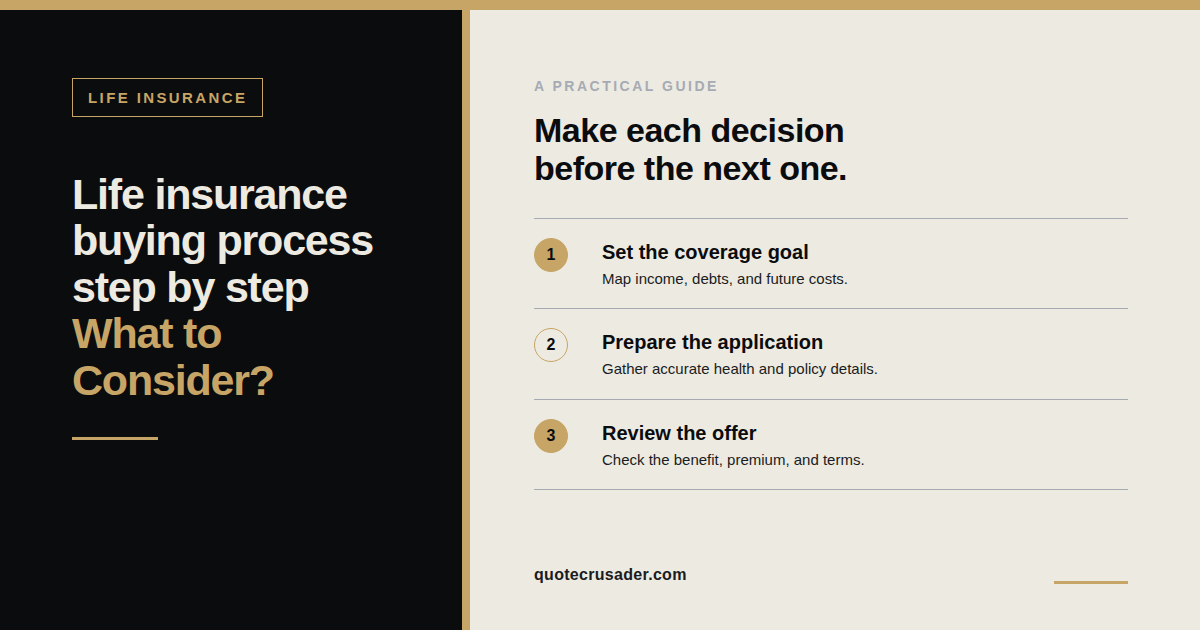
- Define the purpose. Decide whether the benefit should replace income, pay a debt, fund a future expense, or cover services your household would have to buy.
- Set a starting amount. Use a written needs calculation rather than a salary multiple alone.
- Choose the structure. Compare term and permanent coverage by length, premium commitment, and the way each policy is designed to work.
- Prepare the file. Collect identity, financial, medical, and existing-policy information before applying.
- Review the offer. Check the final policy against your goal, budget, and beneficiary instructions.
How should you calculate the coverage amount?
A useful starting amount covers the financial responsibilities your household would face after your death, minus resources already available to them. The Insurance Information Institute breaks that exercise into needs such as income replacement, debts, final expenses, and household services.
Write down the costs instead of relying on a single rule of thumb. Include the mortgage or other debt, the years of income your family would need to replace, education or care goals, and services you provide without a paycheck. Then list savings, existing coverage, survivor benefits you can verify, and other assets that would be available.
Revisit the calculation after a marriage, birth, home purchase, job change, major debt payoff, or change in available employer coverage. The goal is to keep the benefit tied to a real financial obligation, not to buy an arbitrary number.
Which policy type should you compare?
Compare term and permanent coverage by the job you need the policy to do. Term coverage is designed for a selected period. Permanent policies are designed for longer-lasting coverage and can have features that affect premiums and cash value. The NAIC Life Insurance Buyer’s Guide is a useful source for questions to raise with an insurer or licensed professional.
Term may fit a temporary obligation such as replacing income while children are dependent or paying a mortgage. A longer-lasting policy may be considered when the need itself is expected to continue. Compare the guaranteed premium schedule, length of coverage, renewal terms, exclusions, and what happens if a payment is missed.
What information should you gather before applying?
Gather a government-issued ID, contact details for your doctors, a current medication list, recent diagnoses and treatment dates, income and occupation information, existing policy details, and the amount and purpose of the requested benefit. The exact checklist depends on the application and the insurer.
Accuracy matters more than speed. If you do not know a date or dosage, say so and ask how to verify it. Keep a copy of what you submit. A clean, consistent application reduces avoidable follow-up and gives the underwriter a clearer record to evaluate.
What happens during underwriting and a medical exam?
Underwriting is the insurer’s review of the application and risk information used to decide whether to offer coverage and on what terms. The NAIC explains that traditional life underwriting can involve a physical exam, blood or urine testing, physician information, and medical records.
If an exam is requested, a paramedical professional may measure height, weight, and blood pressure and collect samples. Answer health questions fully, including medications and prior diagnoses. The exam is one part of the file, not a guarantee of a particular rate.
Some accelerated processes may skip a physical exam and use information from sources such as prescription history or motor-vehicle records. The NAIC notes that eligibility and data sources vary, and that a traditional review can take much longer than an accelerated path. Ask what route applies to your application and what would cause the insurer to request more information.
How long does the application review take?
The review can take hours for some accelerated applications or months for a traditional file. The timing depends on the application, the requested amount, the health history, and how quickly records or follow-up answers arrive. The NAIC describes both the faster accelerated path and the longer traditional issuance path.
Check the application portal or ask the licensed professional which item is outstanding. Respond promptly, but do not guess. A rushed answer that conflicts with your records can create more delay than a careful answer supported by the right document.
What should you check after an offer is issued?
After the insurer issues an offer, compare the policy document with the application and the goal you wrote down. Confirm the insured person, benefit amount, premium schedule, coverage period, beneficiary instructions, exclusions, and any riders. Ask for an explanation of a term you cannot define in plain language. Reading the offer is the last stage in what happens between applying and getting your policy.
Do not cancel existing coverage until the replacement policy is active and you have confirmed the change is appropriate. If the offer differs from your expectations, ask what changed and whether a different amount or structure would solve the problem. You can decline an offer that does not fit. If you are considering a replacement, buying life insurance step by step includes comparing both contracts for cost and coverage gaps.
Which mistakes can make buying life insurance harder?
The most avoidable mistakes are choosing an amount without writing down the need, leaving out health or policy information, focusing only on the first price shown, and failing to read the delivered policy. The NAIC consumer guidance recommends comparing policies and asking questions about the coverage before buying.
Do not assume that skipping an exam is always better, that the lowest premium has the right structure, or that every application follows the same timetable. Compare the terms that matter to your household and keep copies of the application and final documents.
How can you make the process easier?
You can make the process easier by writing the coverage goal first, preparing a complete health and medication history, and asking what the next outstanding item is after each step. A licensed life insurance agent can explain policy language and help you understand the application, but the final policy documents control.
Once you know the amount and type you want to explore, an estimate can help you decide whether the budget is realistic. It uses the information you provide and does not guarantee approval, a rate, or a final policy offer.
When you are ready, use the estimate path to see an initial rate for your situation. Bring the coverage amount, policy type, age, state, and health details you can verify. Then use the result as a starting point for a careful application and policy review.
Insurance Researcher & Writer
Hannah McCullough is the Director of Operations for Insurance By Heroes, overseeing policy handling, compliance, and customer service. A former teacher and coach, she served more than six years in public education and holds a Master of Education in Educational Leadership from East Central University.